
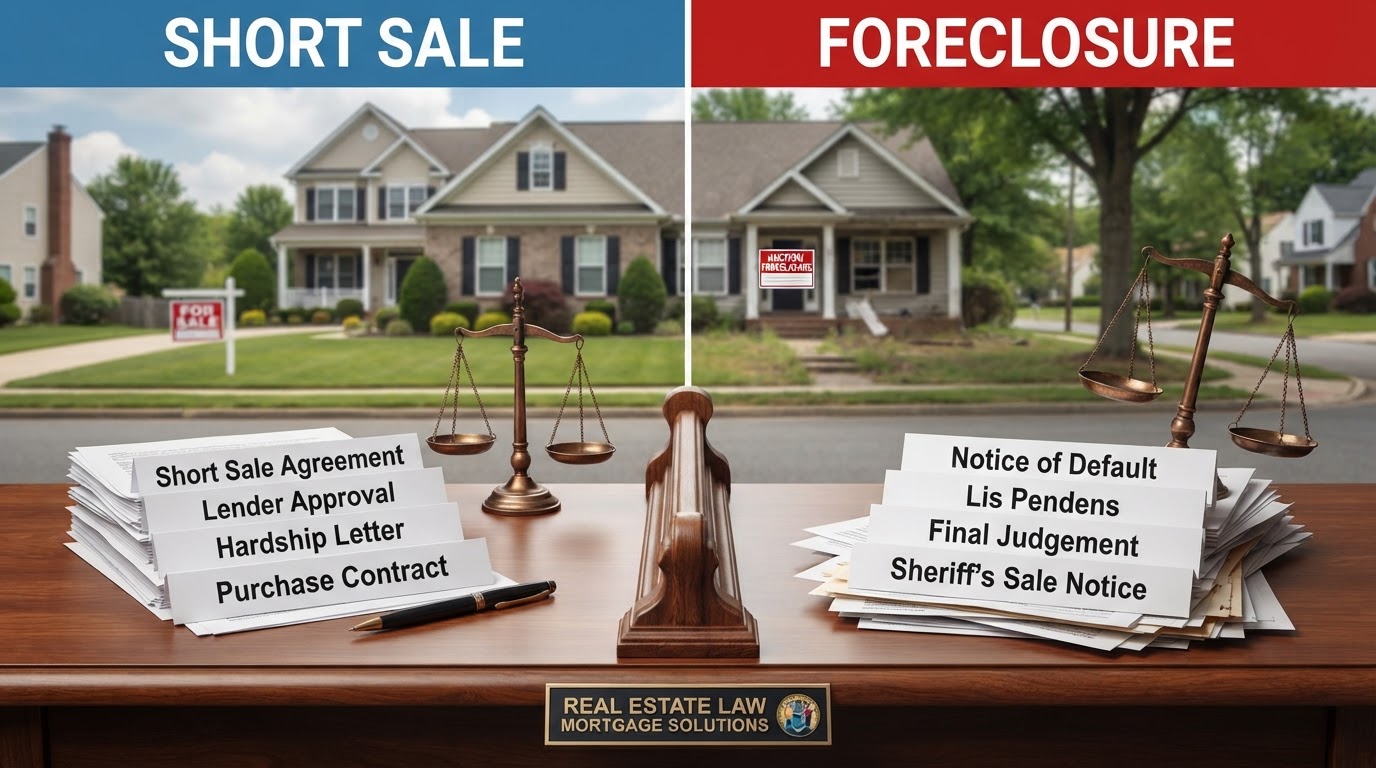
When you owe more on your mortgage than your home is worth and you can no longer afford the payments, you have two main paths: negotiate a short sale with your lender or let the property go to foreclosure. Both will affect your credit and your finances, but in very different ways. Understanding the difference is the key to making the right choice for your situation in New Jersey or Florida.
What Is a Short Sale?
A short sale is when you sell your home for less than the remaining mortgage balance, with the lender's approval. The lender agrees to accept the reduced payoff and release the mortgage lien. You remain in control of the sale, choose the buyer, and the transaction closes like a normal sale. Learn more on our short sale help page.
What Is a Foreclosure?
A foreclosure is when the lender takes back the property through the court system and sells it at auction. In New Jersey, this is a sheriff sale. In Florida, it is a judicial sale conducted by the clerk. You lose ownership, face eviction, and the foreclosure becomes part of the public record. Both NJ and FL are judicial foreclosure states, so the process goes through the courts. Learn the full timeline in our foreclosure timeline guide.
Credit Impact: Short Sale vs. Foreclosure
This is where the two options diverge most significantly:
- Short sale: Typically drops your credit score by 50 to 150 points. Late payments leading up to the short sale also appear, but the mortgage is reported as settled. Most homeowners can qualify for a new mortgage in 2 to 3 years.
- Foreclosure: Can drop your credit score by 100 to 250 points or more. A foreclosure stays on your credit report for up to 7 years and can delay your ability to get a new mortgage for 3 to 7 years, depending on the loan type.
Timeline Comparison
- Short sale: 3 to 6 months from listing to closing, depending on lender approval speed.
- Foreclosure in NJ: 6 to 12 months or longer through the court system, plus a 10-day redemption period after the sheriff sale.
- Foreclosure in FL: 4 to 8 months through the courts, with the redemption period ending at the time of sale in most cases.
Costs and Deficiency Risk
In most short sales, the lender covers the real estate commission and closing costs as part of the negotiated payoff, so your out-of-pocket costs are minimal. In a foreclosure, you may face eviction costs, potential deficiency judgments, and years of credit repair expenses.
In both New Jersey and Florida, lenders can pursue deficiency judgments if the property sells for less than the mortgage balance. However, many lenders waive the deficiency as part of a short sale agreement. Foreclosure deficiencies are more commonly pursued. You can also explore a deed in lieu of foreclosure as an alternative that may include a deficiency waiver.
Future Mortgage Eligibility
- After a short sale: FHA loans may be available in as little as 1 year if you were current at the time of the short sale. Conventional loans typically require 2 to 4 years.
- After a foreclosure: FHA requires 3 years. Conventional loans require 7 years. VA loans require 2 years. The waiting period is measured from the foreclosure sale date, not when you stopped making payments.
Which Option Is Right for You?
A short sale is almost always the better choice when it is feasible. It is less damaging to your credit, costs you less out of pocket, gives you more control, and lets you recover faster. However, a short sale requires lender approval and takes time, so you need to start early enough to complete it before the auction.
If you are not sure which path fits your situation, start with our options comparison tool or visit our pre-foreclosure help page. For a complete overview of every way to stop the process, read our guide on how to stop foreclosure.

Christian Tibok
REALTOR serving homeowners across New Jersey and Florida. Christian helps homeowners navigate complex situations with honest options and no judgment. Learn more about Christian.