
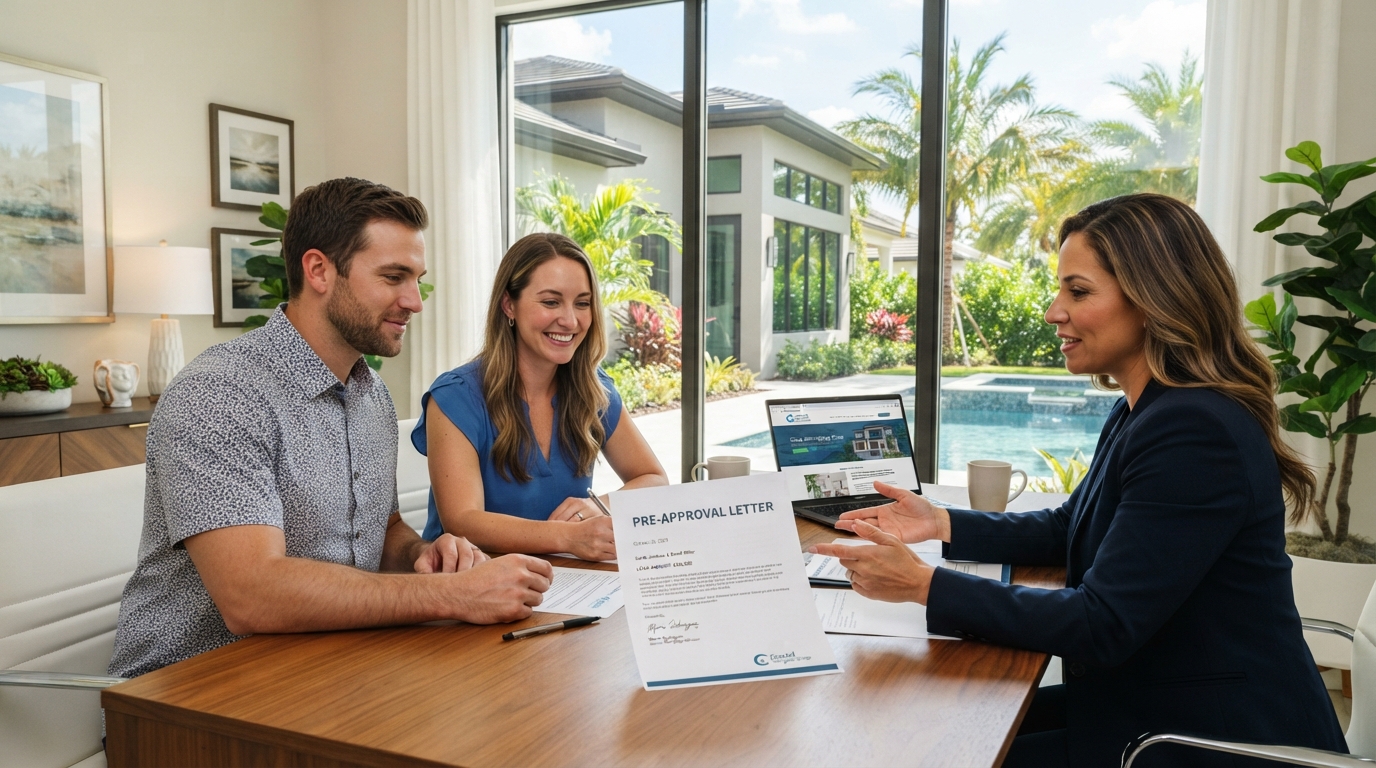
A mortgage pre-approval is a lender's conditional commitment to lend you a specific amount based on a verified review of your credit, income, assets, and employment. In Florida's 2026 market — where inventory has risen but sellers still favor serious buyers — a pre-approval letter is the single most important document you can carry into a home search. It tells you exactly what you can afford, shows sellers you can close, and lets you act fast when the right property appears. This guide walks through every step of the Florida pre-approval process, the documents you need, how much you can borrow, and how Florida's insurance and tax picture affect your approval.
Pre-Qualification vs. Pre-Approval: Know the Difference
These two terms are often used interchangeably, but they are very different in strength. Pre-qualification is a quick estimate a lender gives you based on information you self-report, without verifying any documents or pulling a formal credit report. It takes minutes but carries little weight with sellers. Pre-approval is a thorough review in which the lender pulls a tri-merge credit report and verifies your income, assets, and employment against actual documents. The resulting pre-approval letter is what Florida sellers and listing agents actually want to see. Always aim for a full pre-approval before you start touring homes.
What Lenders Verify During Pre-Approval
A pre-approval is not a guess — the underwriter reviews four core areas of your financial life:
| What's Verified | What the Lender Looks For |
|---|---|
| Credit | Tri-merge credit report, middle FICO score, payment history, and recent inquiries |
| Income | 2-year history, stability, W-2s or tax returns, year-to-date pay stubs |
| Assets | Bank statements proving funds for down payment and closing costs, sourced and seasoned |
| Debts | All monthly obligations used to calculate your debt-to-income ratio |
Documents Checklist: What to Gather Before Applying
Gathering your paperwork ahead of time is the fastest way to speed up your pre-approval. Most delays come from missing or incomplete documents, not from the lender. Here is the standard checklist:
- Two years of W-2s (or 1099s / full tax returns if self-employed, often with year-to-date profit-and-loss statements)
- Two most recent pay stubs covering 30 days of year-to-date earnings
- Two months of bank statements for all accounts (checking, savings, brokerage)
- Statements for retirement or investment accounts if used for reserves or down payment
- A list of all debts and monthly obligations (loans, cards, support)
- Government-issued photo ID and Social Security number
- Divorce decree or separation agreement, if applicable (for obligation documentation)
- Explanation letter for any large, recent deposits or credit inquiries
Self-employed Florida buyers should expect closer scrutiny — lenders typically average two years of net business income and may require a CPA-prepared profit-and-loss statement. For a full walkthrough of the buying journey that follows pre-approval, see our step-by-step Florida home buying guide.
How the Pre-Approval Process Works in Florida
- Submit your application and document package to a lender (often online or through a loan officer)
- The lender pulls a tri-merge credit report from all three bureaus
- An underwriter reviews your income, assets, debts, and credit history
- You receive a pre-approval letter stating your maximum loan amount, loan type, and an estimated rate (subject to rate lock)
- You shop with confidence, knowing your true budget and that sellers will take your offer seriously
This process usually takes 24 to 72 hours once your documents are in. Some lenders offer automated pre-approval in minutes for well-qualified borrowers with clean credit, but verified pre-approvals still require document review. This information is educational and does not constitute lending advice.
How Much Can You Borrow? The DTI Rule in Florida
Lenders determine your maximum loan amount primarily through your debt-to-income (DTI) ratio. Most programs cap your total monthly housing payment (principal, interest, property taxes, insurance, and HOA — known as PITIA) at about 28% of your gross monthly income, and your total monthly debts (PITIA plus car loans, student loans, credit cards, and support) at 36–43%. Here is how that plays out on a Florida purchase:
| Gross Monthly Income | Max Housing Payment (28%) | Approx. Max Loan (at ~7%) |
|---|---|---|
| $5,000 | $1,400 | ~$175,000 |
| $7,000 | $1,960 | ~$250,000 |
| $9,000 | $2,520 | ~$325,000 |
| $12,000 | $3,360 | ~$440,000 |
The Florida catch: high homeowners insurance and, in many areas, flood insurance must be counted inside that housing payment. A $4,500 annual Florida insurance premium adds $375 a month to your PITIA — which can reduce your maximum loan amount by tens of thousands compared to a lower-insurance state like New Jersey. Always ask your lender to estimate Florida insurance in your pre-approval, not a national average. For help estimating your full budget, see our how much house can I afford guide.
Florida-Specific Factors That Affect Your Pre-Approval
Several Florida-specific items shape your pre-approval that buyers relocating from out of state often underestimate:
- Homeowners insurance in DTI: Florida premiums of $3,000–$6,000+ annually are included in your housing ratio and can shrink your max loan. Get insurance estimates before finalizing your budget.
- Flood and wind coverage: In many Florida zones, lenders require flood insurance and windstorm coverage, adding hundreds per month. See our Florida insurance and wind mitigation guide.
- Homestead tax savings: Florida's Homestead Exemption can reduce assessed value by up to $50,000 and caps annual increases, lowering your property tax estimate — but you can only file after closing. See Florida Homestead Exemption explained.
- Title company, not attorney: Florida closings are handled by title companies, and the contract is binding on signing — there is no New Jersey-style 3-day attorney review. Your pre-approval needs to be solid before you make an offer.
- Down payment assistance: Florida programs like Hometown Heroes and Florida HLP can provide up to $35,000 in assistance, which may change your required cash to close. See our Florida first-time buyer programs guide.
How Long a Pre-Approval Lasts
Most pre-approval letters are valid for 60 to 90 days. After that, the lender typically re-pulls your credit and may request updated pay stubs and bank statements. If interest rates move significantly, your pre-approved rate may change unless you locked it. If your home search extends beyond the letter's expiration, ask your lender for a refresh — it is usually a quick update, not a full re-application.
Common Reasons Pre-Approvals Get Denied (and How to Avoid Them)
- New debt before closing: Financing a car or opening a credit card after pre-approval can push your DTI over the limit. Hold off on new credit until after closing.
- Job changes: Switching jobs or moving to commission-only income mid-process can void an approval. If a move is unavoidable, tell your lender immediately.
- Unsourced deposits: Large cash deposits that cannot be traced can stall asset verification. Document the source of any large deposit.
- Credit score drops: Late payments or new inquiries after pre-approval can drop your score below the program minimum.
- Understated debts: Forgetting to list a student loan or support payment skews your DTI and surfaces in underwriting.
How to Shop Lenders the Smart Way
It is wise to compare offers from two or three lenders — a big bank, a mortgage broker, and a credit union — because rates, fees, and turn-times vary. The good news: multiple mortgage credit pulls within a short window (typically 14–45 days, depending on the scoring model) count as a single inquiry, so shopping within that window has minimal impact on your score. Compare the Loan Estimate (LE) each lender provides — focus on the interest rate, origination charges, and lender credits, not just the monthly payment. For loan-type options that may fit your situation, see our FHA, VA, and USDA loan guide and our Florida down payment guide.
Why Pre-Approval Matters in Florida's 2026 Market
Florida's 2026 market is more balanced than recent years — inventory has risen to roughly 4.5 months and days on market have grown to 40–60 — but sellers still prefer or require pre-approved buyers. A pre-approval letter shows you can secure financing, which reduces the risk that a deal will fall through, and it lets you act quickly when the right home appears. It also helps you shop with confidence because you know exactly what you can afford, including the Florida insurance and tax costs that shape your real monthly budget. For the broader market picture, see our NJ & FL housing market update.
Related Articles for Florida Home Buyers
Down Payment Requirements in Florida
What Credit Score Do You Need to Buy a House in Florida?
Buyer Closing Costs in Florida: A Complete Breakdown
How to Buy a House in Florida: A Step-by-Step Guide
Florida First-Time Home Buyer Programs and Grants
Ready to Start Your Florida Pre-Approval?
Christian Tibok works with buyers across New Jersey and Florida and can connect you with trusted Florida lenders, walk you through the document checklist, and help you understand exactly what you can afford — including the insurance and tax costs that shape your real budget. Visit our Pre-Approval resource page or explore the full buyer guides hub.

Christian Tibok
Licensed real estate professional with Fathom Realty NJ LLC & Fathom Realty FL LLC. Christian helps buyers across New Jersey and Florida find the right home with honest advice, local expertise, and a no-pressure approach. Learn more about Christian.